Pages

Showing posts with label DigiLit Sunday. Show all posts

Sunday, August 6, 2017

Stamina

Within the dim lit room a peace settled; a celebration brewed. Participants came together as a community. The yoga teacher took her position guiding, modeling moves, and providing support, and so it began - a two hour yoga celebration of joy. 
Flor Villazan at Come Together Yoga Studio

Prior to entering the room, I wondered if I had the stamina to make it through two hours. My muscles ached from the return to yoga after vacationing but I was willing to try. With determination, I engaged in each move in the best way I could. I monitored my speed, listened to the cues my body was giving, and did not hesitate to keep trying. 

For a brief moment, as I moved in and out of poses, my mind interrupted the flow. The word stamina surfaced. It was the prompt word for DigiLit Sunday and I was planning on writing about it. Realizing that it was stamina that I needed, I took in a fresh breath and continued. The energy in the room and the passion of the teacher provided the stimuli to finish strong and celebrate along with the others.

Come Together Yoga Studio, Long Island
Today, I reflect upon the two-hour experience and relate it to teaching. 
  1. What does it take to build a culture of trust and engagement? You need an air of positivity, care for humanity, choices, and belief in the human spirit. In the yoga studio a positive environment was established, community honored, choices provided, and the teacher believed in each participant's ability.
  2. What does it take to sustain a task? For learners, it takes confidence, determination, support, and stamina. 
  3. How do we encourage learners to engage in tasks that may be difficult? Teachers full of passion are the guides on the journey. They enter the learning space with enthusiasm and provide the support needed. As in yoga, teachers instruct, model, release responsibility to the learner, guide, and support. Learners respond to the varied moves in a culture of trust and sharing because they are honored as unique individuals with individual needs. 
  4. Why should we celebrate the difficulties and frustrations of learning? Learning is a celebration of moves that lead to accomplishment. Whether the success is small or great, learners should be applauded for their contributions within the learning space. 
Today, I join Margaret Simon and the DigiLit Sunday writing community on the topic of stamina. My takeaways from the yoga session (where I clearly needed stamina) are: to succeed as a learner, determination, persistence, and practice are needed. Understanding that practice is a step toward progress, not perfection allows each learner to become an active participant in a non-judgmental atmosphere. 

Saturday, June 3, 2017

Celebrating Story

While I wait to hear the news of the arrival of my granddaughter, our first grandchild, I gather items that I will bring to Virginia for the event. Stories unfold as I collect the memorabilia: a photo album of my daughter's first years of life, an embroidered little robe, decades old but as fresh as when it was first worn, and a quilted blanket. These pieces, among others once cherished, have come full circle as I piece together a story for the new generation.

I celebrate the women in my life who came before me, 
nurtured me, and led me to a world of learning.

I celebrate my daughter, 
now ready to bring a daughter into this world
to make her mark on life.


Story unfolds with time.
Tales progress, reflecting like 
a mirror upon our familial lives.
Torn photos, mementos, family treasures, 
worn with years, touched by tears, share stories


and so the story lives on
with new life.

Stories build upon stories as life twists and turns with each new bend of the path. Where the story goes is part of the wonder of a new generation of storytellers. With faith, these new eyes will see the beauty of life and find a path to walk as many have done before.

************

I celebrate with others who have stories to tell
and open their doors to listen to mine.
Thank you Ruth Ayres for the space to Celebrate Life This Week.


Thank you Margaret Simon for the space to create 
and play with the DigiLit Sunday Community.

Sunday, April 23, 2017

Celebrating the Earth

Each Earth Day, citizens gather together to find ways to protect our beautiful earth. Think Green is a popular mantra!


URGENT MESSAGE:
As residents of the earth, we need to take on the role of stewards, keep watch over the bountiful creation provided us, and teach students about the challenges of climate change and other local environmental concerns. Adults can model the slogan, Reduce-Recycle-Reuse, to take a small step forward in Earth Day efforts to save Mother Earth. 

Children can also help, as evidenced by the HBO documentary, Saving My Tomorrow, that aired last night at the close of Earth Day. You can view the clip below.

CLASSROOM ACTIVITY:
Classrooms can promote "Earth Day Everyday" by planting trees, recycling, reading about Earth Day at Wonderopolis' Wonder of the Day 1675, How Can You Make Earth a Better Place, and reflecting. To broaden the after-reading experience, 4th to 6th grade students can engage in a writing activity focusing on 10 of the highlighted words in the Wonderopolis text, i.e., earth, public consciousness, future, protection, legislation, global, recycling, rally, action, conserve, plant, trash. Using these words as prompts, students work in pairs to create poems that either celebrate the beauty of Mother Earth or provide insight into ways to save the earth. Recitation of the pair-created poem with another pair enhances the oral reading experience. Asking for feedback allows students to refine their poem. Students create Illustrations, posters, or videos of the class poems to publicize a celebration event.

POETIC FORMAT:

The example I provide below is an adaptation of the Golden Shovel poetic format featured by Writer's Digest. While I enjoy creating this type of poem, I admit that it is challenging.

-Find a quote that appeals to you about your subject.
-Use each word in the quote as an end word in your poem.
-Keep the end words in order.
-Give credit to the person who wrote the quote.

QUOTE:
The earth is what we all have in common. 
- Wendell Berry
MY RESPONSE:
There is beauty in fragile flowers, the
turn of light upon the grass. The earth
wrapped in shades of vibrant hues is
resplendent in springtime, but what 
if we neglect our mighty land?  Will we
deplete earth of its riches or of all
it has bestowed on mankind. Have
we forgotten what is necessary in
our haste to have superfluous interests in common?
©Carol Varsalona, 2017


Yesterday was Earth Day 2017 
but 
EVERYDAY should be Earth Day! 

Let's band together to honor the earth through advocacy and simple steps to focus on becoming faithful stewards of the environment.


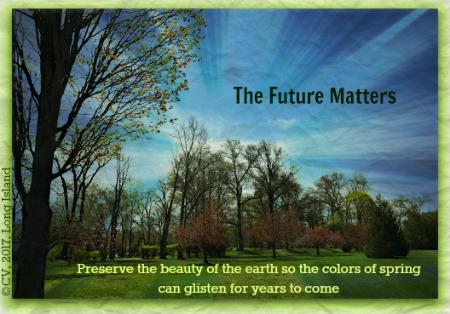
The image poem and inspirational message above are part of my #poetrylisciouspoetry collection for National Poetry Month 2017.

Thank you, Margaret Simon for suggesting the topic for #DigiLitSunday and creating the digital flyer below.


Thank you, Ruth Ayres for providing space each weekend to Celebrate This Week with fellow bloggers.


This post is also part of my Wonder Bundle of activities that I am creating for Wonderopolis as part of my commitment to being a Wonder Lead Ambassador. Do you often wonder how you can help protect the earth?

Sunday, April 9, 2017

Celebrate Springtime

"Let your joy burst forth like flowers in the spring." 

-author unknown- 


It is on the weekends that we can look back, celebrate the highlights of the week, and enjoy family time.  Let me paint you a picture of springtime Long Island through digital poetry.

Mother Nature dressed earth this week in a
kaleidoscope of color: 
smoky-colored skies, 
blue-gray mornings, 
pastel-hued sunsets, 
and verdant lawns. 


****************

I celebrate springtime and all it brings this week-from the dampening rain to the spurts of sunshine to a spring day and the budding of my garden.  The progression can be recognized through my digital poetry in a collection of #poetrylisciouspoetry.


Seasonal Change began the week.

April awakened the writer inside!

Rainy days brought inspiration.

A spring morning restored liveliness.  


Spring paraded its newest hues as it moved from rainy forecasts to days filled with sunshine. Springtime signposts were visible and Long Island exploded with outdoor activity. 

spring kaleidoscope
burst with faint hints of color
liveliness restored
putting spring in my step
nature's artwork visible

****************

The digitals and poems in this post are part of my #poetrylisciouspoetry collection for National Poetry Month and offered today to two writing communities, Ruth Ayres' Celebrate This Week and Margaret Simon's DigiLitSunday. 


The Winter Wonder Gallery I created has wonderful examples of digipoetry from across the world. The sample is from Margaret Simon.


I hope everyone celebrates springtime with zest this week. 

Sunday, March 26, 2017

March Musings 26: Burning Questions

Margaret Simon asked writers in the DigiLit Sunday writing community to think about the topic, Burning Question, this week. Many relevant, burning questions have been posed lately on Twitter educational chats. As one of the moderators of #NYEDChat, I know that it is important to pose both timely topics and questions that ask connected colleagues to reflect on critical topics. 

Some examples of topics and questions are:
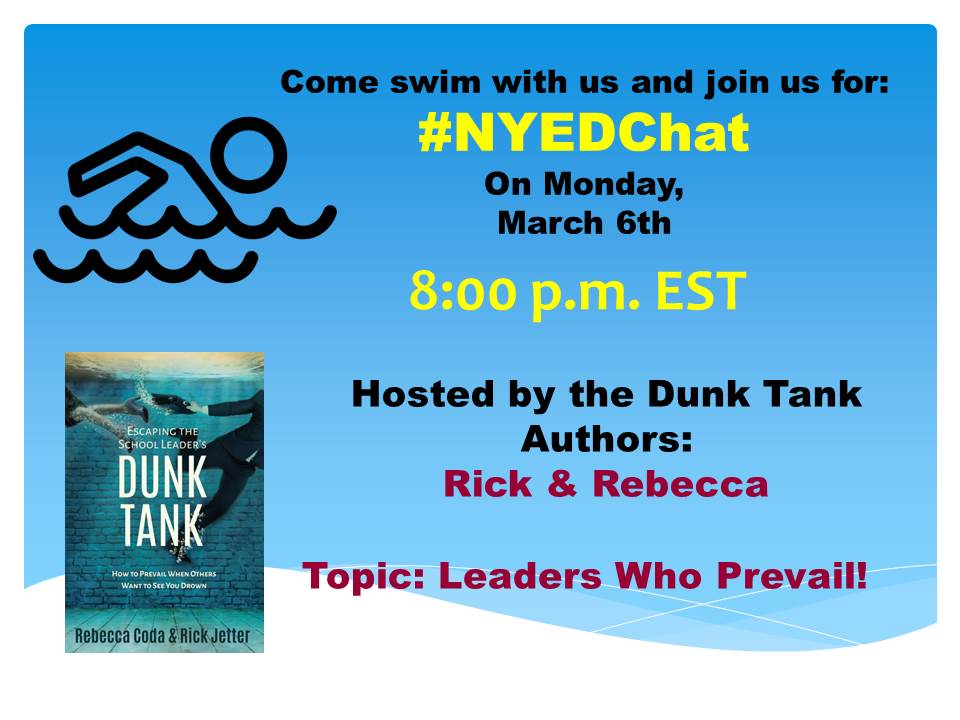
“Prevailing” is not linear.  It is a lifelong process.  What is one specific thing that you can do this week to continue being a difference-maker in your school or district?

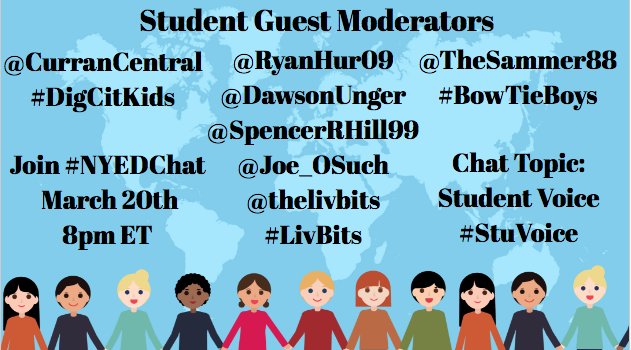
How do #StuVoice opportunities connect and empower students to develop empathy for causes & movements outside of their comfort zone?

5.2.16 #NYEDChat.jpg
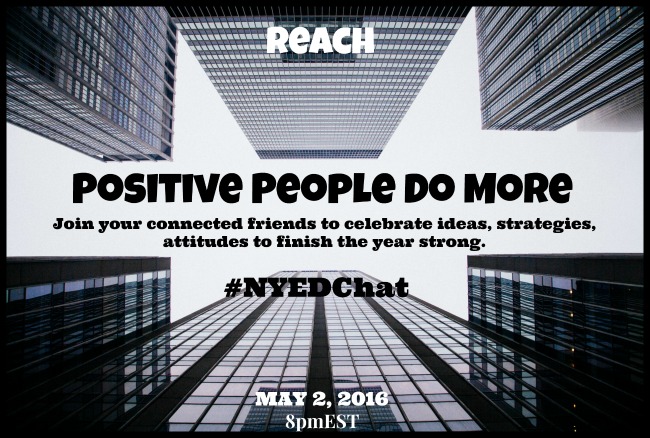
Why do we need to be a tribe of positive champions?

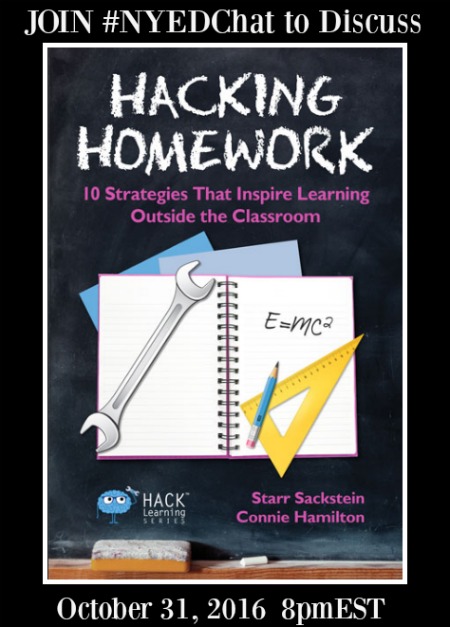
Is homework valuable?
How can we reimagine homework to be a more effective learning experience?

I created the following What if poem to reply to the burning questions on the homework  topic.  (The format is a zeno created by the imaginative J. Patrick Lewis, Children's Poet Laureate from 2011-13.)

Have you engaged in Twitter chats where the burning question allowed you to reflect deeply?

This is my twenty-sixth posting in a series titled March Musings for Two Writing Teachers' March Slice of Life Story Challenge, that addresses the DigiLit Sunday topic, Burning Question. Please visit both communities of writers to see the vast array of topics and writing styles. 


Sunday, March 19, 2017

March Musings 19: Innovation

In a world driven by technology, information is prized but this is not the end game. 

Late 1990s:
At that time, when school reform models were being examined, my elementary school's magnet microsociety program was built on the Accelerated Schools model to "accelerate all students to high levels of achievement". All students were offered authentic, "real-world" learning experiences based on the content area of study. They were expected to notice, wonder, question, examine, analyze, make decisions, and work with teammates in a creative setting so that new knowledge would be constructed and exhibited. Constructivist theory was evident.

Examples:
Since the school was trying to provide authentic learning experiences, teachers and magnet coordinators met regularly to develop the program. At the 2nd grade level, one classroom of young scientists watched bird feeding patterns as part of their environmental studies and community living literacy program. Teams of students logged in daily observations in their journals, created charts with their findings, and presented short reports. 4th grade young historians delved into daily life in NYS and constructed authentic vignettes throughout the school with information and artifacts gathered. They also took on different roles as developers of a living museum. This was part of their combined literacy/social studies program. 

21st Century Creative Models:
Fast forward to today. The growth mindset encourages educators to honor all learners and their different learning styles in student-centered classrooms where the collection of information is only part of the journey. The wonder of learning and the application of knowledge are valued during Genius hour, 20% time, and passion projects, contemporary versions of my early PBL learning experiences. Discussions, collaboration, explorations, and time to create are part of these authentic learning opportunities where choices are provided and agency developed. Classrooms like these are evident across the world.  

Professional Development:
To support teachers interested in enriching, challenging programs for students, educational chats on Twitter and edcamps have sprouted up to discuss the whys and hows of student-centered authentic learning and innovation. 

George Couros, an "innovative teaching, learning, and leadership consultant" and author of The Innovator's Mindset, has introduced the innovator's mindset for educators to ponder. The sketchnote below explains Couros' thinking.


Couros provides discussion questions that we can ask ourselves when developing new, relevant learning activities. One that I feel is important is: What is an example of a practice that you would consider to be innovative? How is it new or better than what you had before?

Reflection:
During the late 1990s, when the microsociety was created, the program was considered to be innovative for elementary students. We studied other schools that had similar models at the secondary level and visited one at the elementary level. We linked with the regional BOCES center and presented at workshops. This was before the innovator's mindset was developed. Success was based on the level of involvement of each classroom, as it always is. 

Actionable Step To Take:
As dedicated educators, we need to constantly create better programs and student-centered learning experiences; provide teachers with support to become the guides on journeys toward wondrous learning; equip students with the tools to become life ready, lifelong learners. Is this doable? Absolutely, it just takes commitment, energy, and passion. 


This post is the 19th in the series titled March Musings for Two Writing Teacher's March Slice of Life Story Challenge.  It is also offered to the DigiLitSunday community under the topic, innovation, offered by Margaret Simon.


Sunday, March 12, 2017

March Musings 12: Blended Learning

As educators of the digital age, do we ask ourselves how do we keep face-to-face contact with students and still make room for digital time? 

Student-centered classrooms are filled with teachers who have direct contact with students in best practices, such as direct teaching, mini-lessons, small group instruction, and conferencing. Digital components are intermixed as students wonder and inquire about topics of interest. Allowing students choice lets them become owners of their learning under the guidance of teachers who are the facilitator/coaches on the journey. Blended learning activities provide teachers the opportunity to make exploration and discovery an important part of each student's day that leads to individual growth as a meaning maker. 


Created with Tagul Word Clouds

Combining a digital element with face-to-face learning is being explored in classrooms across the globe in various ways. Wonderopolis, a free site where the wonders of learning never ceases, provides opportunities for classrooms and individual learners to extend their learning through the exploration of topics of interest via its free, online site. Students who are interested in their topic can continue the learning at home with their parents, siblings, and friends. This technology-based learning can easily be integrated into daily learning experiences during the school day. Small groups of children could join together to study one wonder of the day while another team chooses to dig deeper into another topic. Wondering will lead students from classroom studies to technology-based explorations and discoveries.  

If you are looking for a deeper look at blended learning, you can examine the Edutopia article, Blended Learning: Combining Face-to-Face and Online Education by Heather Wolper-Gawron. In this article, the author examines 5 components needed for blended learning. 

Reflecting on the topic of blended learning offered by Margaret Simon at DigiLit Sunday has allowed me to ponder the idea of keeping face-to-face contact with students while still making room for digital time. Please let me know how you make the two mesh in your classroom and if you are a Wonderopolis user. 


This post is the 12th in the series titled March Musings for Two Writing Teachers' March Slice of Life Story Challenge. 
DigiLit Sunday