Showing posts with label Wonderopolis. Show all posts

Friday, October 20, 2023

Celebrating the Book Birthday of "The Thing To Remember About Stargazing"

Did you know that books have birthdays? It is not a party with cake and candle blowing but it is a splendid send-off into the world on the day the book is published. Come celebrate a wonder-filled children's book, THE THING TO REMEMBER ABOUT STARGAZING, by one of my talented children's book author and poet friends, Matt Forrest Esenwine. October 3, 2023 debuted the arrival of Matt's amazing book published by Tilbury House and illustrated by Sonia Maria Luce Possentini. Matt has a magical touch when writing and his newest book combines the wonder of the evening sky and the lure of "just being" still on a starlit night. 

Let's take a look at the book trailer premiere that gave the kidlit world a sneak peek into "this picture-book ode to stargazing with an underlying message of awe for the wonders of nature". 


Nature provides wonderers with so many awesome sights to see in this world. If you look closely at the front cover of Matt's book you notice the glow of the evening sky. Does this bring you back to your childhood? Did you once upon a time, trace the sky with your eyes and listen to the sounds of stillness? In a poetic way, Matt offers a voyage back into time or a new experience for those who cannot now see the amazing pictures glowing in the sky. 

The intro to the book reminds us that not only humans look to the sky at night. All creatures do."The stars look down on us all, and we all gaze upward. The night sky binds us together." This one line makes me reflect on a world at crossroads and how important it is to remember we all live on this great big planet. This book with its mindfulness theme offers a gentle new way to reflect in silence.

The illustrations enhance the magnitude of Matt's choice of words and the simplicity of his message for all. "The most important thing to remember about stargazing is...to do it."

After the end of this beautifully imagined book is an informational text, The Stars In Our Eyes, written once again from the poet's perspective. A new word for most children, asterisms, is introduced. "Images and patterns that we see within constellations are known as asterisms. Matt even adds a whimsical game to the act of stargazing. ...You can find your own asterisms in the night-sky-just connect a few dots (i.e.,stars) and come up with a name for the image you imagine. Perhaps you'll discover the Leaping Platypus, the Great Pickup Truck, or the Ancient Crazy-Haired Teacher."  
I posed the following Questions for Matt to answer.

1. When you began your journey of writing this book, how long did the total process take?
The book took nearly 10 years from the time I wrote the original poem to the date it was published. In-between, it went from a poem titled "A Beginner's Guide to Stargazing" to a picture book manuscript titled, "The Thing to Remember About Stargazing" - and there was a lot of revision going on there, as well! You can learn more about the backstory here: https://writersrumpus.com/2023/10/06/the-thing-to-remember-about-stargazing-a-lesson-in-learning-to-rewrite-revise-recycle/Within this thought lies the truth about writing. "Passion, Persistence, and Patience Counts!"

2. What is your process when creating a title for your books? 
As far as titles, half the time a title will come to me and I'll write the book around that, and half the time an idea will pop into in my head and I'll get the book halfway done before the title comes to me. But I like having a title as early in the process as possible, because it sort of keeps me on track, focused on the story/subject, almost like a compass pointing north. In the case of Stargazing, I had no choice but to change the title, so I used a line from the book as the title because it summed up the narrative very nicely.
A piece of interesting information about Matt's successful career as a writer, poet, children's author: Matt is sending out StoryWalk(R) copies of his new book to two dozen libraries across the state of New Hampshire.

As a certified Wonderopolis wonderologist, I am constantly wondering. Perhaps, classroom children would like to find out Why Do Stars Twinkle?  Find the response at Wonderopolis' Wonder of the Day #1818. 
Thank you, Matt, for allowing me to enter your big universe of stargazing as I used to do as a child. Your book inspired me to write a small poem.


Within this book, I found a small poem

found
within this book
a universe of stars
a pathway to wonder
awe-struck, stilled moments
©CVarsalona, 2023
Today is a happy day at Bridget Magee's blog post, wee words for wee ones. She is not only happy to be the Poetry Friday host but celebrate another year around the sun. Bridget has "decided to lean hard into happy because right now the world needs happy".

Friday, September 1, 2023

The Museum on the Moon

Most people I know love viewing the many faces of the moon in the night sky. Many stare and wonder about its marvels; others take moon photos or view the moon through a high-powered telescope. But did you know that the moon goes beyond being a phenomenon in the sky? It is also a museum of curious objects.
"The most curious museum on Earth isn't on the earth at all; it's on the moon"? 

Author and poet, Irene Latham, thoroughly researched why the moon is a curious museum prior to writing her fascinating new book with an interesting title, The Museum On The Moon-The Curious Objects on the Lunar Surface. Her book is so engaging that not only children but adults will be enthralled with Irene's addition of nonfiction information and a variety of poetic formats. In turn, Myrim Warers, the illustrator, created a series of magical scenes throughout the book that bring clarity to Irene's poems and non-fiction information. Their combination of artistic talents created a children's book that is out-of-this-world exciting.

When Irene introduced her new book, I immediately expressed interest in reviewing it. I thought it fortunate to not only see the book prior to public release but to enjoy virtually flying to the moon with Irene. I do admit that I was curious to view the artifact collection left on the moon. Perhaps, you, also have been inquisitive about the moon and lunar visits. My interest started when the American astronaut, Neil Armstrong, became the first person to step onto the moon (July 20, 1969) and declared, "That's one small step for man, one giant leap for mankind".  

If we peek into the book we will find a beautiful blend of word choice, poetic formats, interesting historical facts, and artwork. This is the type of book that will provide worthwhile night reading for families and a resource for teachers and librarians. Also, this book would provide hours of inquiry at a science/literacy wonder station, alongside Wonderopolis' articles on the moon, such as Wonder #128 How Much Do You Weigh On the Moon?  Teachers could pair this Wonder of the Day with Irene's poem on Gravity.

The book begins with a Table of Contents that draws children's attention. Some children may be inclined to skip to a particular title that delights them or follow the traditional way of reading a book. I indulged in a few moments reviewing the titles that are great introductions to the book itself. "The Junk Side of the Moon" caught my eye and I wanted to know more but I started with the first poem and nonfiction piece, Welcome Earthlings. Below is a portion of Irene's first poem using the triolet format.

Think you know the Moon 

because you see it every night?... 

So many artifacts hide in plain sight! 

Don’t think you know the Moon 

just because you see it every night. 


My curiosity was piqued immediately, so I eagerly awaited the collection of poems that unveiled artifacts that were left on the moon. At first, I wondered why the astronauts would leave personal possessions, their tools, equipment, and even golf balls but then, I started thinking about the Oregon Trail pioneers who left many of their beloved possessions along the side of the road. I did find out the reason though. Because astronauts were bringing back to Earth items from the moon for scientific research, they needed to divest themselves of heavy objects. I also found out from Irene's research that the aim of the NASA Apollo Program "was not to create a museum. The program aimed to establish space technology, carry out scientific exploration of the Moon, and to develop ways for humans to work in the lunar environment." Irene added links to various aspects of the program at the end of the book providing a pathway for children to complete a small research project in collaborative groups. 

Forever Footprints was the second poem that also used great word choice: "Human tracks tattoo Moon's rutted face-". Children will enjoy the imagery in this poem and most likely will need a dictionary to gain access to the meaning of some words, which is a wonderful way to introduce a worthwhile reading skill. The poem, "Invisible" made me stop and ponder the wonder of stardust and moon dust that merge hope, prayers, wishes, and dreams-come-true. The nonfiction piece on the left of the poem provided an inspirational goal-in-motion thought.


I extend thanks to Irene's publisher, Bushel & Peck, under their poetry imprint, Moonshower. Moonshower "publishes artful, exciting volumes of poetry for kids of all ages by some of the world's leading poets. Irene Latham is a notable figure in the children's poetry field. As you can see from the sneak preview, she is a thoughtful writer with a fine sense of how to create books that will empower children to become wonderers, readers, and writers. She writes to expand children's imaginations and also to promote creativity and children's potential to expand their horizons. 


Because digging into the whys of writing a book is important, I asked Irene to respond to two burning questions I posed.

1. Why were you drawn to researchng information on "The curious objects on the lunar surface"?
I was definitely one of those "space kids" who followed the Apollo missions and watched space movies (Space Camp, anyone?) and visited space museums. (Huntsville Space and Rocket Center is less than two hours away!) And our eldest son also had a big obsession with space, so it felt like I've had this books inside me for a long time! 
2. How did you decide which poetic format you should use when composing each poem?
I knew I wanted to use a variety of forms (thank you DICTIONARY FOR A BETTER WORLD), but I didn't set out to write any one poem in any particular form. I just kind of played around, and eventually (sometimes, immediately, as in the poem "Peace", which is an adaptation of an acrostic) a form would make itself known. I think I spend most of my time as a poet setting poems free from the constraints/expectations I come into the poem with...it's hard sometimes (and takes time!) to just let a poem be what it wants to be! But it's kind of essential, because in my experience, that's how one catches the best poems.

With delight, I opened my email today to Irene's responses. As parents, teachers, and librarians, it is important to understand the endless possibilities that books provide. Irene is one of those deep-thinkers who desires to open children's eyes to the magic of books. 


Below are some artifacts that Irene sent me to brighten my days I prepared to write this book review.

Artful Photography
Inspirational Poetry

Remembrance of the Apollo Missions Into Space

When Irene hosted Poetry Friday on June 30, 2023, she asked the community of writers to join her "Moon in June" themed Roundup. She created a Welcome to the Museum on the Moon! padlet here so others could enjoy the poetic goodness that came in different styles. I offered a Moon in June blog post with four moon-related poems and photos. You can see my offering here.

Note: Due to printing delays, the published date for the Museum on the Moon by Irene Latham is now set for September 19, 2023. This book will become the 19th children's book that Irene has written and a wonderful gift for any child, educator, or librarian. 

I've always been smitten by the moon and now I add Irene Latham's artistic and creative book, The Museum On The Moon-The Curious Objects on the Lunar Surface, to my wonder list of items that awe me. 

🌑🌙🌕🌑🌙🌕


Today, I offer the Poetry Friday community a peek into Irene Latham's newest book with the hopes that everyone spreads the news across social media, into classrooms, and libraries. Children benefit from books that spark their imagination and who knows perhaps there are little stargazers, astronauts, and scientists in the making who will grow up to honor the moon and all the Apollo missions. 

Thank you, Ramona Behnke, for hosting Poetry Friday today. I know that you are busy with your move across the country. May your new view bring many walks of peace to your late summer days.

Tuesday, May 2, 2023

Surprise at Dawn

I woke to light cracking through the edges of the shades. While this is not unusual, I was tired and longed to continue my sleep. A lulling sound permeated the air. I was intrigued and slowly walked to the front door where the sweet sounds of birdsong were. Surprised, I stood listening to the dawn chorus, a cacophony of birdsong, from the trees in the wood facing my house. Since I recently heard of the phenomenon called the dawn chorus, I wanted to learn more. Luckily, I woke early on this first day of May, a peak time to enjoy the sweet essence of birdsong.

The dawn chorus is the singing of wild birds that closely precedes and follows sunrise, especially in the spring and summer. (Merriam-Webster Dictionary) 

Join me at the Dawn Chorus May Celebration


Nature video of the dawn chorus on May 1, 2023.

Are you interested in learning more about the Dawn Chorus? 

**********************

Engage in Student Fun Activities at a Wonder Station: 

  1. Check out the Wonderopolis Wonder of the Day, Who Sings in the Dawn Chorus
  2. Ask students to write a cinquain poem. See the sample above. Use the Cinquain Poem Generator as a template.
  3. Create a Word Art digital at https://wordart.com/. See the sample above the poem.
  4. Visit the Museum of Zoology here.
  • **********************
  • Join me at Two Writing Teachers for the Tuesday Slice of Life.

Tuesday, February 22, 2022

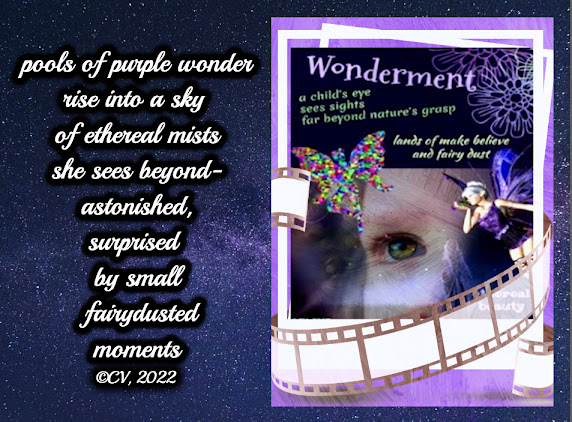
Fairydusted Moments

As you may know, my one word this year is appreciate. I try to find beauty in this world but always seem rushed for time to pause and "just be". At best, I should slow down. When I read a piece Margaret Simon recently wrote, I stopped to think. "Appreciate time for what it is." Time is fleeting but it does provide magical moments if we take the time to look. 

In yesterday's poetry prompt created by Susan Michelle Brisson for Laura Shovan's 10th Annual February Poetry Project, one word, wonderment, stood out. I fell in love with that word several years ago. It has a magical quality to it. I knew that I created a digital inspiration years ago for a business card so I pulled it out of my poetry vault and added an additional poem in a new graphic design for the challenge.

I think of myself as a wonderologist ever since the days of being a Wonder Lead Ambassador for Wonderopolis. I am curious about life and continually honor the beauty of nature that often surprises and astonishes me. 

In this fast-paced world of medical and ecological concerns, it is easy to overlook the importance of slowing down and just being. Today, I shall remember the words by Suzy Kassem, "Never stop wandering into wonder." 

It's Tuesday Slice of Life at Two Writing Teachers, a Meeting Place for Reflective Teachers.
May your day be filled with fairydusted moments and your night with starlight.

Friday, February 8, 2019

Winter Bee Surprise

It was an ordinary winter day. I walked into the kitchen to do ordinary tasks when I saw something from the corner of my eye. I could hardly believe it. Walking on the rim of my large pot was a yellow bee. Quietly, I gasped. I watched in wonder and then, quickly went into fear mode. It sounds odd but it was just seven months ago when I got a big surprise. I encountered a hive of yellow jackets in my backyard-Ouch

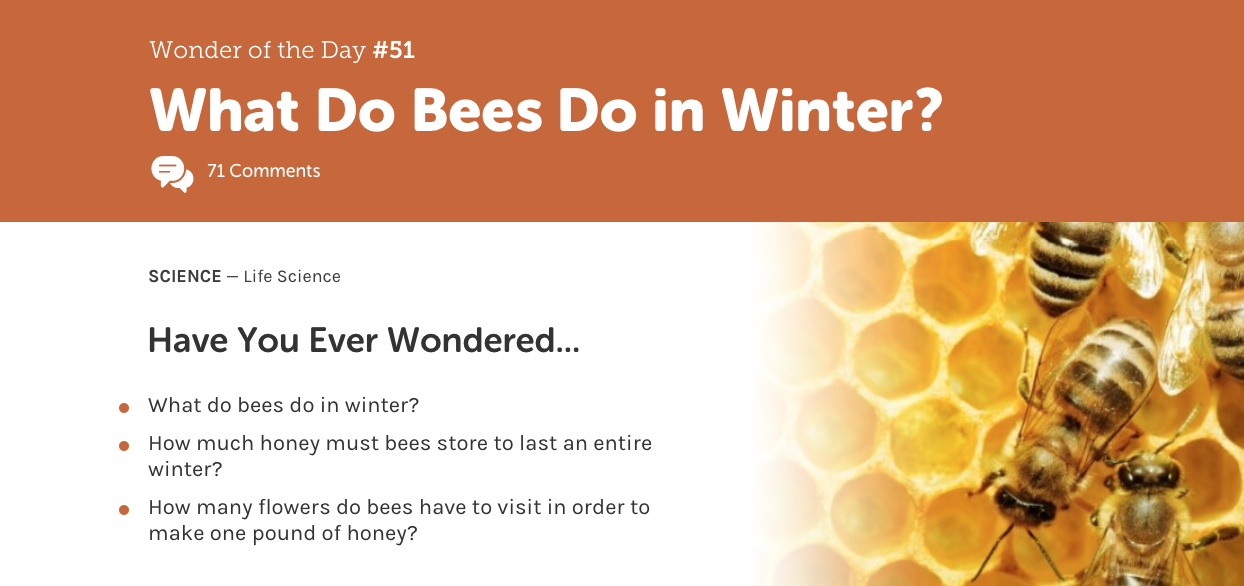
Fast forward to this week of professional development and I decided to feature my story to stir wonder in others. Why was a bee in my kitchen? I turned to Wonderopolis' Wonder of the Day #51


Then, I found Naomi Shihab Nye's poem, chose a strike line, and retold my story throguh a golden shovel poem.

Bees Were Better by Naomi Shihab Nye

In college, people were always breaking up.
We broke up in parking lots,
beside fountains.
Two people broke up
across a table from me
at the library.
I could not sit at that table again
though I did not know them.
I studied bees, who were able
to convey messages through dancing
and could find their ways
home to their hives
even if someone put up a blockade of sheets
and boards and wire.
Bees had radar in their wings and brains
that humans could barely understand.
I wrote a paper proclaiming
their brilliance and superiority
and revised it at a small café
featuring wooden hive-shaped honey-dippers
in silver honeypots
at every table.
Poem copyright ©2008 by Naomi Shihab Nye, “Bees Were Better,” from If Bees Are Few: A Hive of Bee Poems, Ed., James P. Lenfestey, (University of Minnesota Press, 2016). Poem reprinted by permission of Naomi Shihab Nye and the publisher.

From Strike Line:
"I studied bees, who were able
to convey messages through dancing"

To: Golden Shovel

It happened quickly, as I
Was washing dishes. I studied
Him wondering where other bees
Were hidden, those who
Knew how to attack, were
Destined to persist, and able
Enough to target me as food to
Sup on. I slowly approached to convey
My thoughts on his presence. Messages
Were sent out through
Multiple swipings as he continued dancing.
©CVarsalona, 2019


*****************************

Each Friday, I  join my poetry friends for Poetry Friday. Today, children's poet Laura Purdie Salas is the Poetry Friday Roundup host at her blog site, Writing the World for Kids


Thursday, October 18, 2018

"Octopus Month" Poetic Fun

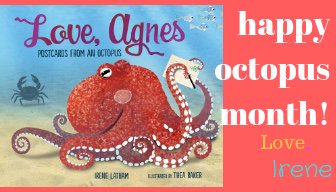
When poet Irene Latham wrote a post, Desperately Seeking Octopus Poems and Art #Octo NationI knew I had to find out what that was all about. I searched Twitter but did not see a #hashtag for #octopusmonth. As I scanned Irene's blog, I realized that Irene was celebrating her newest release from Millbrook Press/Lerner, Love, Agnes - Postcards from an Octopus. To honor Agnes, she christened October as "Octopus Month" and then, requested some octopus poems and art to post on her blog. That is how Ona Octopus came to be a digital creation.


Ona Octopus
came to school.
I tried to hide her
in layers of tulle.
My friends came close
to see the surprise.
Ona changed color
right before their eyes.
The class jumped back
at Ona's plight.
It's not Halloween,
so what's the fright?
Teacher said, "Lesson learned."

Ona is scared and concerned.
Octopus use camouflage.
Science class is now adjourned."
©CVarsalona, 2018

Thanks Irene, for creating such a fun challenge from the delightful Agnes. Image result for love agnes postcards from an octopus

My Back Story: 
Many people know that I have a grandbaby that I am over the moon about. I decided to write a children's poem to be read to my dear little toddler, Sierra, who is a wonderer at such a young age. Information came from Wonderopolis' Wonder of the Day #1404, How Do You Hide an Octopus?  I turned the details into a wonder poem, a poem that emerges from a Wonder of the Day. Because it is nearing Halloween, I decided to add that tiny detail and create my own octopus, Ona, with the Buncee platform. Ona excitedly sent Agnes and all of you a postcard from the deep. My next step will be to record the poem so Sierra can hear her family reading it to her even though we are hours away from her. 


Today's Poetry Friday Roundup is hosted by a very busy writer, Brenda Harsham, who celebrates autumn with a gorgeous nature photo and a haiku. Stroll over to her blog to take a peek. 

Tuesday, October 16, 2018

Celebrate Summer Collapsing Into Fall

Time has passed since summer officially closed its seasonal celebration of a sunkissed life. I have held onto this season in my heart, recalling sand-swept beaches of Long Island with their heated breath seeping through gentle winds. The salty spray of the Atlantic Ocean taste is still on my lips. With this picture in my mind, I nostalgically longed for lazy, sun-chasing days and nights that were full of light and energy in the late evening UNTIL I recently passed over the Mario Cuomo Bridge. 

As I crossed the newly girded steel structure leading me to upstate New York, I noticed a hint of color here and there; leaves were different from the green ones of a Long Island summer. Moving further north, the preponderance of multi-colored sightings were evident. Mother Nature, the glorious artist, must have spent all weekend painting the land in warm hues. A newly-awakened landscape emerged before my eyes. 

It was in that moment of awareness that I knew summer collapsed into fall, ushering in a new season to savor. I was in awe of nature's breathtaking change in scenery. The colors emerging from each town's tree-lined highway appeared to be woven into a vast patchwork collage.


The sight was awe-inspiring, much more than the first scattered gathering of leaves upon my deck.

Other colleagues understood the magnitude of the changing of seasons
and so the collecting of autumn photos began.

From Maine came Molly Hogan's first sighting.
Brian Rosinzky sent the following from South Dakota.
Mark Weston captured an early fall scene while hiking in the Rocky Mountains.

Have you ever wondered about the why behind the color change?
Check out Wonderopolis' Wonder of the Day #1325 for information and 
enjoy watching the 30-second time lapse of summer turning into fall.


ln case you are still wondering about seasonal color change, please take a quick peek at last year's global gallery of artistic expressions while I continue to explore autumn. 
🍁🍂
Thank you Two Writing Teachers for your Tuesday Slice of Life space.
Also, thank you, Ruth Ayres, for encouraging all writers to Celebrate This Week