Pages

Sunday, March 3, 2019

Snow! - March Musings '19/#SOL19/Day3

It came upon an evening clear
with its purpose to adhere.
There was no announcement, no fuss
but its intention to discuss. 
Shocked by the fluffy, billowy stuff
I waited for a rebuff.
Perhaps a task to shovel away
white beauty this Saturday? 
"No way," he emphatically said.
And so the saga of nature's gift
waits quietly for man's snow shift.
©CV, 2019 


Winter's Embrace


Afterthought: The sun came out, just like my husband said, so he did not have to take a snow shift.  

Equation Poem: (poetic form created by Laura Purdie Salas)
Gray day + below freezing temperature = snow 
Snow - freezing temperature + sun = nature's snow removal

⛄

I am now ready to join the #SOL19 community for the March 12th Annual Slice of Life Story Challenge Day 3 created by Two Writing Teachers!


3/31

Friday, March 1, 2019

A Fresh Perspective on Black History Month


Each year, educators observe Black History Month. Looking for a fresh perspective, I researched works of contemporary artists and found Loveis Wise's vivid representation of Black History Month at the Poetry Foundation. Her artwork above showcases a diverse group of Black Americans looking backward into their ancestors' past while others contemplate the future. I paired this drawing with Latorial Faison's powerful poem, What is Black History?, to create a multi-dimensional lesson design on Black History for my professional development program. Fashion's reverent reflection is filled with visual imagery spanning centuries that emphasizes the power of story.

What is Black History?
from 28 Days of Poetry Celebrating Black History 3
by Latorial Faison (2012)

It is the dirt road our forefathers trod, 
Memories of their lives branded in our hearts. 
It is a word, a place, a state of mind. 
Black history is a peek into our ancestors' time. 
    
It is a piece of fabric our grandmothers wore, 
An old rope that our grandfathers lived to deplore. 
It is a slave ship and middle passage over seas. 
Black history is cotton fields and tobacco leaves. 

It is a plantation overseer and back door crumbs, 
Weeping and wailing, a beating of drums. 
It is a troubling truth, an unapologetic past. 
Black history is an entire race struggling to last. 

You can read the lines leading to the last two lines here.

LAST LINES

It is every single experience of our history.
Black history is the story of you and me. 

⨠⨠⨠⨠⨠

While February 28th is the close of Black History Month, historical moments live on as does the following line from Fashion's poem.

Memories of their lives branded in our hearts.

THIS LINE NOW SERVES AS THE STRIKE LINE FOR A GOLDEN SHOVEL POEM I DRAFTED.

When thinking of the past, memories
reveal feelings of
pride, pain, family, and their
legacy in a chain of not-forgotten lives.
Within each happening branded
in retold stories and in
places of prominence, our
memories are held in our hearts. 
©CV,2019

⨠⨠⨠⨠⨠


I started writing this post after watching Good Morning America the morning of February 28th. Singer, songwriter, and Grammy winner, India Arie, performed a song, What If, honoring Black American trailblazers in history and this became the inspiration behind my design of a multi-faceted lesson that can be delivered during and beyond Black History Month. 

In order to assist our students in becoming culturally literate, we need to present black history as a prominent piece of America's past, present, and future. Contemporary artists, poets, and songwriters are critical deliverers of the message.


⨠⨠⨠⨠⨠

This post will serve a dual role as I offer it to the writing communities of
Poetry Friday and Two Writing Teachers.

Poetry Friday is hosted this week by a true poetry lover, blogger, and writer, Linda Baie, my friend from Denver. Linda's interest in anagrams has led her to grow a poem for spring. Join me at her blog post, TeacherDance to be delighted by her word choice and rearrangements that will surely brighten your winter days. 


Two Writing Teachers is launching their Slice of Life Story Challenge 2019 for the month of March. There are already 213 educators who have posted their blogs at the site. My series will be titled March Musings 2019.

Tuesday, February 26, 2019

Winter Wail

In the middle of the night, a howling began that disturbed my sleep. Half-awake, I tried to ascertain the origin of the incessant wailing noise. Was I dreaming? Was someone in distress? Where was the sound originating? I stumbled into the bathroom to look out my window. There was an eeriness unfolding. I watched the silhouette of majestic trees swaying back and forth in a hurried manner. 


When morning arrived there was a chilled calm in the neighborhood. Winter Wind left its calling card and the prospect of chilly weather for the week.

Winter has been an interesting season this year on Long Island so I continue to write documenting what I notice and wonder. Have you been intrigued by nature this winter?


Today is the final warm-up before Two Writing Teachers' month-long writing challenge begins on Friday, March 1st. I'm ready! 


Thursday, February 21, 2019

#haikulove for H is For Haiku

Did you know that February is National Haiku Writing Month? I did not realize that until today but I have been spreading #haikulove throughout the month. In keeping with the haiku celebration this month, I am sharing an amazing treasure trove of A to Z haiku from Sydell Rosenberg (1929-1996), an accomplished poet whose imaginative poetry will delight you and hopefully inspire you to read and even write haiku.


 ✥

For decades, Amy Losak, daughter of poet Sydell Rosenberg, worked tirelessly to make her mother's dream of publishing H Is For Haiku, A Treasury of Haiku From A to Z come true. On April 10, 2018, the dream became a reality; Sydell's book was published. Amy and I have been exchanging messages about her mother's book for several months so I am excited to showcase Sydell's work and provide readers with Amy's perspective on the charming and whimsical way her mother envisioned haiku. 

Haiku is that fledgling moment when
the wingstrokes become sure-when the
bird has staying power in the air
-Sydell Rosenberg


Parents, educators, and children will fall in love with Sydell's small nuggets of thoughts on city life and nature in H Is For Haiku. Her book is an invitation to slow down, pause, and savor the small moments of life. Let's take a look inside this treasure trove of haiku happiness.


✥

In light of the recent snow that has fallen on Long Island and larger amounts in other parts of the country, I present Sydell's haiku for the letter C:


My little grandbaby would be upset if her baby could not be retrieved from a buried car but this dolly appears to be excited about her adventure. Sydell's 5-7-5 syllable pattern and child-friendly wordplay heightened by Sawsan Chalabi's imaginative illustration and visually appealing font provide the right amount of whimsy for a winter tale. 


✥

The meteorologists accurately reported that Long Island's snow would come and go, so the following haiku by Rosenberg seems appropriate, especially since my husband usually forgets to take in my Grandmother's vintage watering can. 


In this imaginative haiku celebrating the letter D, the arrangement of raindrops from a human-like cloud brings nature to life and invites us into the poem.

✥


In this haiku featuring the letter H, don't you just love that Rosenberg compared umbrellas to mushrooms and that Chalabi's brightly colored artwork captures the intent of the poem in a fanciful way? Based upon the Long Island weather report, this morning I thought I would see a line of children with umbrellas like the one above but nature had other plans. The sun decided to appear instead of the predicted rain. At least, I have this haiku to remind me that weather can be damp and wet but sparkly, too. 


✥


I hope you are intrigued by the sneak peek of H Is For Haiku. There are 26 haiku in this charming alphabet book for little ones and adults. Now let's turn our attention to Amy Losak and her journey to fulfill her mother's wish.

✥

Interview with Amy Losak

1. Amy, how did you begin the process of showcasing your mother's work?
The process was slow and halting. It took me such a long time to mobilize, for various reasons having to do with my own innate tendency to procrastinate, my fear and lack of self-confidence, and my continuing and paralyzing grief over my mother's sudden death in 1996. Thanks to the support of many understanding people, I finally began to make some small but eventually steady strides in reviewing and organizing some of her copious work. This was around 2011,

At one point, I had a kind of Eureka moment: I remembered that, a long time ago, mom had one idea in mind for illustrating her manuscript, if it ever became a book: children. I came up with my own, related idea to contact nonprofit children’s art education organizations and offer mom’s “word-picture” haiku as teaching tools. I also contacted various other organizations serving kids: nature and literacy groups, child life specialists, etc., with my ideas to integrate the beauty of haiku into their educational, creative, or therapeutic programs.

At last, I connected with an outstanding New York organization, Arts For All (arts-for-all.org), and they “got” my vision. We’ve had a successful partnership for several years now. I fund the teaching residencies. AFA teachers have used a number of mom’s haiku in two city schools (one in the Bronx, one in Queens) to help teach the basics of drawing, painting, and collage; music; and theater, to mostly second-grade students (and other grades, as well). I’ve had an opportunity to visit the two schools several times to discuss mom’s haiku and share some of her story (it’s important that they connect the words to a real person: the writer). The teaching artists are so talented and dedicated, under the amazing leadership of Executive Director, Anna Roberts-Ostroff.

Other rewarding endeavors I have engaged in:
-Programs with the Children’s Museum of the Arts (Manhattan), the Queens Botanical Garden (Queens, NY), and the Teaneck Creek Conservancy (Teaneck, NJ).
-Free event at the Poets House in Manhattan. 
-Upcoming workshop on April 25 for Poem In Your Pocket Day-https://poetshouse.org/event/poem-in-your-pocket-day-2/

2. What do think of the way the illustrator visualized your mother's haiku?
Sawsan Chalabi’s art is wonderful–full of vim and joy and I love the clever lettering. The poems are an integral part of the illustration. Schalabi.com

3. What are your next steps for promoting the concept of small moments?
I hope to continue interacting with young people in various settings on the potential for haiku to elicit and capture an appreciation for the “small moments” that surround our daily lives. I also hope to publish another haiku picture book, perhaps one that combines my work with my mom’s. It’s in the works!

4. What would you like to add to our discussion, Amy? 
I view myself as an eternal beginner. I started writing haiku late and I have a lot to learn. This is fine! For me, it's more about the process than the results. Writing haiku has opened my eyes and all my senses to the myriad small moments that can be treasures, if we only take the time to perceive them. I enjoy writing haiku, even though it’s anything but easy. Of course, this process helps me stay connected to my mom. Poets study and practice this form seriously for years. It's a dedicated community that is global. I feel fortunate to be part of it, thanks to social media.

5. Let's list the accolades for your mother's book, Amy.
-Chosen by National Council of Teachers of English as a 2019 Notable Poetry Book
-Nominated for the 2018 Cybils Award in Poetry 
-Included in SCBWI's 2018 Official Reading List
-Selected by Amelia Island Book Festival in Florida for its Authors in Schools program
-Received 35 ratings and 20 reviews on Goodreads.com
-300 third grade students at Yulee Elementary School attended Amy Losak's presentation and        received copies of H Is For Haiku

As Amy says, "Some of Syd's short poems (a few were published decades ago) have a city sensibility. But they also have a universal, timeless appeal. Haiku are brief: they impel young readers to slow down and linger over something they may ordinarily overlook, and perhaps find bits of magic there."

I would like to thank Amy Losak for continuing conversations with me so the magic of her mother's delightful haiku could be showcased during National Haiku Writing Month.

✥

I close with my version of a weather report for Long Island


and what I imagine Virginia weather would be like.


These digital inspirations were humbly designed using Rosenberg's delightful haiku and Chalabi's imaginative illustrations as mentor texts.

✥

This week, Poetry Friday is hosted by the talented poet, experienced haiku writer, and creative entrepreneur, Robyn Black at her blog site, Life on the Deckled Edge. Please circle back during April for National Poetry Month when all the Poetry Friday poets will be celebrating.


Save the Dates:
4/17/19 - International Haiku Poetry Day
4/26/19 - Poem In Your Pocket Day

*Interested readers can purchase a copy of H Is For Haiku: A Treasury of Haiku from A to Z, by Sydell Rosenberg and Sawsan Chalabi (Penny Candy Books) at your favorite local or online booksource.

Tuesday, February 19, 2019

Quiet Reflection

As seasons pass from one to another, my writing life grows in its daily practice of observing ordinary, life-living moments. Why I ask do I seek to weave golden threads of thought into delicately-formed patterns? Is it to adorn even the grayest of days or find peace in the simplest of acts?

And so I write
in the stillness of quiet corners,
in the midst of sublime joy 
and chaotic discord.
I journey onward,
a traveler and observer
seeking inspiration,
finding quiet spaces where
wonder spreads its wings,
like a butterfly fluttering in the wind. 
Nurtured by curiosity, 
I reflect upon nature's patience
and persistence in its
seasonal interplay with life.
I pause to dream, ponder, and imagine
words taking root to find their purpose
in a hurried world that forgets
beauty exists in both
the ordinary and the sublime.
©CVarsalona, 2019

As I eagerly mull over the prospect of engaging in a month of writing for the 12th Annual March Slice of Life Story Challenge, I feel each new day of writing deepens my practice and allows me to explore my writing life from different perspectives. Join me as I try out new moves, revisit past techniques, and capture other's thoughts to broaden mine. 

Thank goes out to Leigh Anne Eck for calling together a community of writers to make writing plans for 2019 under the hashtag #letwwrite2019. Today, I wanted to start the journey with a quiet reflection written when the only sounds I hear are the murmurings of the house.

Thanks is also offered to Two Writing Teachers its weekly Slice of Life Tuesday.


Thursday, February 14, 2019

Within Winter's Reach


This year, Lady Winter shared her sense of beauty with the world as she created multiple headlines. She walked the season's runway dressed in various apparels, ranging from frosted snow dustings, gray skies, dampened rains, and patterned ice, providing me with inspiration to create my own digital designs and digipoetry.


Golden Shovel Poem

I started with the strike line, The dust of snow, from Robert Frost's poem, Dust of Snow at https://www.poets.org/poetsorg/poem/dust-snow.

Lady Winter tiptoed into the
dawn spreading frosted dust,
Pausing for wide eyes of
wonder to marvel at her artsnow.
©CV, 2019
©CV, 2019
Line Lifting 
"One must have a mind of winter" and "For the listener who listens in the snow" from Wallace Stevens' poem, The Snow Man.

One must have a mind of winter
to breath in nature's frosty breath,
whisper into the chilled wind,
and be awed by the magic of the dance
in early morning light.
For the listener who listens in the snow,
winter peace is within reach.
©CV, 2019

******************************

Tonight Jone MacCulloch is hosting the Cybils Award Party at her blog site, Check It Out. I am excited to see some author friends' names mentioned as finalists. Time to join Jone. You can access the list of Cybils winners here.


IMG_1077

img_0207

Tuesday, February 12, 2019

Rainy Day Magic

I learned these past few days that rainy days though dreary, in reality, can be magical when you are with your grandbaby. 


Grandmother love is unique.
It wipes away raindrops;
Warms a chilly day.
Leads me to bookstops
And filters sky's gray.
©CV, 2019


Listen to a piece of rainy day music here.


On this rainy winter day, I am at peace as my grandbaby lays asleep in the next room. Tomorrow I travel back to Long Island but tonight, I am joining Two Writing Teachers for the Slice of Life. 

Friday, February 8, 2019

Winter Bee Surprise

It was an ordinary winter day. I walked into the kitchen to do ordinary tasks when I saw something from the corner of my eye. I could hardly believe it. Walking on the rim of my large pot was a yellow bee. Quietly, I gasped. I watched in wonder and then, quickly went into fear mode. It sounds odd but it was just seven months ago when I got a big surprise. I encountered a hive of yellow jackets in my backyard-Ouch! 

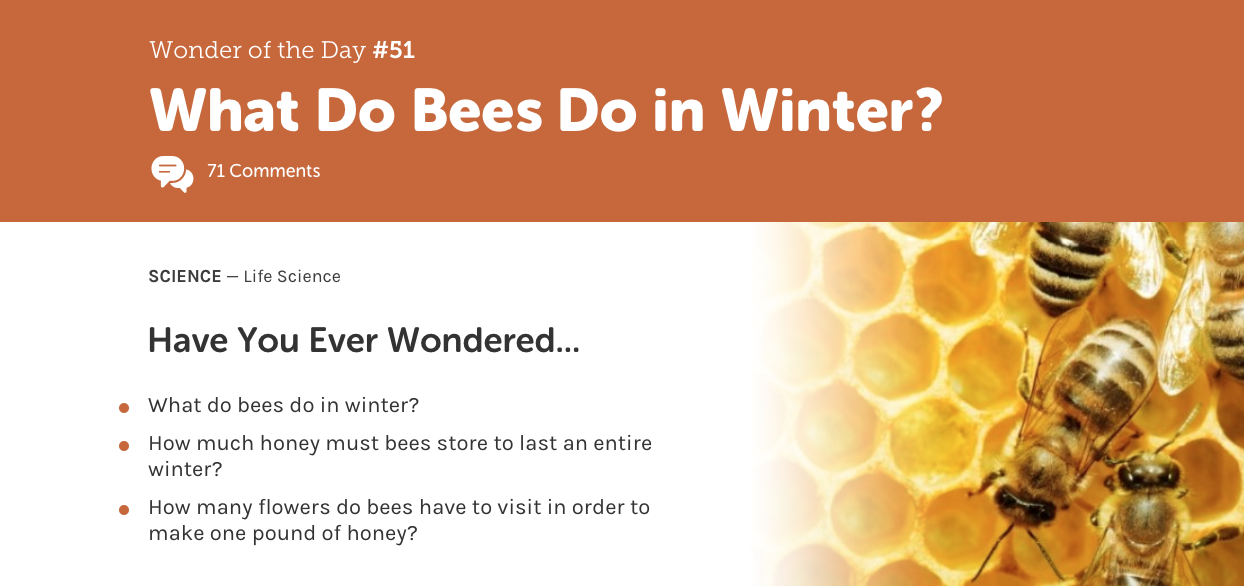
Fast forward to this week of professional development and I decided to feature my story to stir wonder in others. Why was a bee in my kitchen? I turned to Wonderopolis' Wonder of the Day #51. 


Then, I found Naomi Shihab Nye's poem, chose a strike line, and retold my story throguh a golden shovel poem.

Bees Were Better by Naomi Shihab Nye

In college, people were always breaking up.
We broke up in parking lots,
beside fountains.
Two people broke up
across a table from me
at the library.
I could not sit at that table again
though I did not know them.
I studied bees, who were able
to convey messages through dancing
and could find their ways
home to their hives
even if someone put up a blockade of sheets
and boards and wire.
Bees had radar in their wings and brains
that humans could barely understand.
I wrote a paper proclaiming
their brilliance and superiority
and revised it at a small café
featuring wooden hive-shaped honey-dippers
in silver honeypots
at every table.
Poem copyright ©2008 by Naomi Shihab Nye, “Bees Were Better,” from If Bees Are Few: A Hive of Bee Poems, Ed., James P. Lenfestey, (University of Minnesota Press, 2016). Poem reprinted by permission of Naomi Shihab Nye and the publisher.

From Strike Line:
"I studied bees, who were able
to convey messages through dancing"

To: Golden Shovel

It happened quickly, as I
Was washing dishes. I studied
Him wondering where other bees
Were hidden, those who
Knew how to attack, were
Destined to persist, and able
Enough to target me as food to
Sup on. I slowly approached to convey
My thoughts on his presence. Messages
Were sent out through
Multiple swipings as he continued dancing.
©CVarsalona, 2019


*****************************

Each Friday, I  join my poetry friends for Poetry Friday. Today, children's poet Laura Purdie Salas is the Poetry Friday Roundup host at her blog site, Writing the World for Kids.